
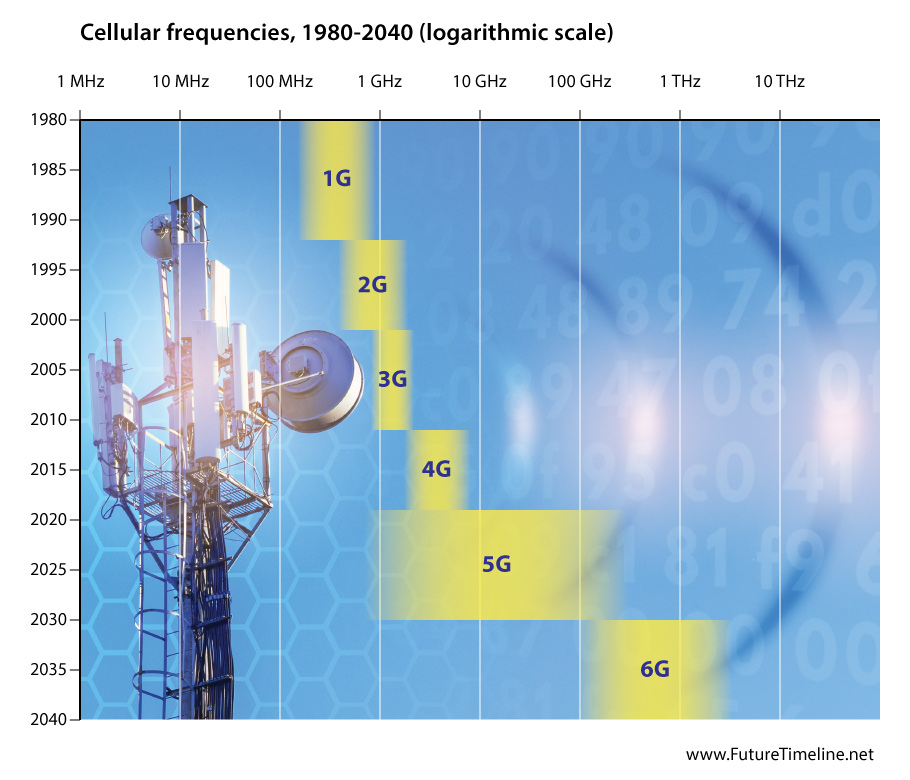
This graph shows the progress in mobile cellular frequency ranges – from the first generation (1G) in the 1980s to the sixth generation (6G) that is predicted for the 2030s.
Sources:
• 1G
“Typically 150 MHz and up.”
https://en.wikipedia.org/wiki/1G
800 MHz
http://www.zseries.in/telecom%20lab/telecom%20generations/
150 to 900 MHZ
https://its-wiki.no/images/c/c8/From_1G_to_5G_Simon.pdf
• 2G
GSM (2G): 380 to 1900 MHz
https://en.wikipedia.org/wiki/GSM_frequency_bands
CDMA: 800MHz and GSM: 900MHZ, 1800MHz
http://www.zseries.in/telecom%20lab/telecom%20generations/
“GSM (TDMA-based), originally from Europe but used in almost all countries on all six inhabited continents (Time Division Multiple Access). Today accounts for over 80% of all subscribers around the world. Over 60 GSM operators are also using CDMA2000 in the 450 MHZ frequency band (CDMA450).”
http://www.thefullwiki.org/2G
• 3G
810 Mhz to 2170 Mhz
http://www.teletopix.org/3g-wcdma/3g-spectrum-allocation/
1.6 to 2 GHz
https://its-wiki.no/images/c/c8/From_1G_to_5G_Simon.pdf
1.8 to 2.5 GHz
https://www3.nd.edu/~mhaenggi/NET/wireless/4G/
2100 Mhz
http://www.zseries.in/telecom%20lab/telecom%20generations/
• 4G
“850 MHz, 1800 MHz”
http://www.zseries.in/telecom%20lab/telecom%20generations/
700 MHz (Band 28 – Telstra / Optus)
850 MHz (Band 5 – Vodafone)
900 MHz (Band 8 – Telstra)
1800 MHz (Band 3 – Telstra / Optus / Vodafone)
2100 MHz (Band 1 – [a small number of Telstra sites] / Optus [Tasmania] / Vodafone)
2300 MHz (Band 40 – Optus [Vivid Wireless spectrum])
2600 MHz (Band 7 – Telstra / Optus)
https://en.wikipedia.org/wiki/4G#Frequencies_for_4G_LTE_Networks
2 to 8 Ghz
https://its-wiki.no/images/c/c8/From_1G_to_5G_Simon.pdf
Additional source for 2 to 8 GHz:
https://www3.nd.edu/~mhaenggi/NET/wireless/4G/
Another source for potential maximum of 8 GHz:
https://www.researchgate.net/publication/301789296…
• 5G
3 to 300 GHz
https://its-wiki.no/images/c/c8/From_1G_to_5G_Simon.pdf
3 to 300 GHz
https://www.researchgate.net/publication/301789296…
700 Mhz to 24 GHz and higher: “along with the 37-43.5 and 66-71GHz bands.”
https://5g.co.uk/guides/4g-versus-5g-what-will-the-next-generation-bring/
A few more countries/stats for 5G:
https://www.rfpage.com/what-are-5g-frequency-bands/
• 6G
https://www.futuretimeline.net/blog/2018/11/22.htm
https://futurism.com/the-byte/the-fcc-clears-new-frequencies-for-6g-wireless-technology
https://www.cnet.com/news/as-5g-looms-chinas-already-looking-at-6g-development/
https://www.networkworld.com/article/3305359/6g-will-achieve-terabits-per-second-speeds.html
Source: https://www.futuretimeline.net/data-trends/11.htm – 05 11 21

 ytd2525